COURSE REVIEWS
Mnidoo Valley Assiginack Wikwemikong Golf Club
By Kiel T. Christianson,
Senior Writer
Manitowaning, Ontario Sometimes non-golfers accuse those of us in the golf world of being a little full of ourselves. And perhaps justifiably so, as we wax philosophical about golf as a metaphor for life, as a game of honor, and as an egalitarian sport that allows players of all levels at any course to compete on a level playing field. The degree to which all of this is true is certainly limited by the fact that golf is just a game, after all, and that historically, golf clubs have been sanctuaries for the wealthy and powerful, where status, class, and ethnicity were practically codified as part of the Rules of Golf. So when the game actually does become a unifying force in a community, and when a golf club genuinely strives to promote diversity and cooperation and succeeds in doing so we who value all that is good about our sport owe thanks.
Mnidoo Valley Assiginack Wikwemikong Golf Club is one such course that deserves our gratitude, not only for reminding us of the power of the game, but also for bringing championship golf to one of the most pristine, beautiful, and historical spots on the Great Lakes. Mnidoo Valley, located on Manitoulin Island in Lake Huron, qualifies on every count as one of the most unexpected and exotic golf destinations in North America.
First lets unpack what is unofficially the longest golf course name in the world: Mnidoo means spirit in the local native language of Odawa (Ottawa), which is closely related to Ojibwa (Chippewa), also spoken in the nearby native community of Wikwemikong. Wikwemikong is the name of the largest First Nations reserve on Manitoulin Island. In fact, Wikwemikong (Wiki, for short) is the only unceded native land in North America. This means that the tribal leaders here never signed over their home to the Canadian (or United States) government. They agreed to stay, but not to relinquish any rights at all to the land.
The golf course is a joint venture between the proud Native community
of Wikwemikong and the non-native community of Assiginack, the
first of its kind in these parts. The two communities came together
in 1997 to form a non-profit organization to build the only 18-hole,
professionally designed course on the island. They hired Kevin
Holmes of MATP in Toronto (who also designed the new course on
St. Joes Island near Sault Ste. Marie) to turn the 154 acres
of rocky, rolling, unkempt land into a fully irrigated, nicely
manicured, yet still pretty wild championship golf
course.
In its second full year of operation, Mnidoo Valley is doing good business and, according to General Manager Mark Stortini, is really coming into its own as both a fixture in the community and as an attraction for the summer-time tourists on the island. The rye grass fairways are hearty in all weather conditions, and the bent grass greens have matured nicely, having suffered no winterkill, thanks to the insulating warmth of surrounding Lake Huron.
And both tourists and local residents are catching golf fever, thanks to Mnidoo Valleys beauty and extremely reasonable rates. Even in the Native community, in which no one golfed just a few years ago, the sport has become the fastest-growing past time. According to Stortini, a remarkable 60% of the courses clientele are from the Native community, despite the fact that no one has been able to come up with a good word for the sport in Odawa.
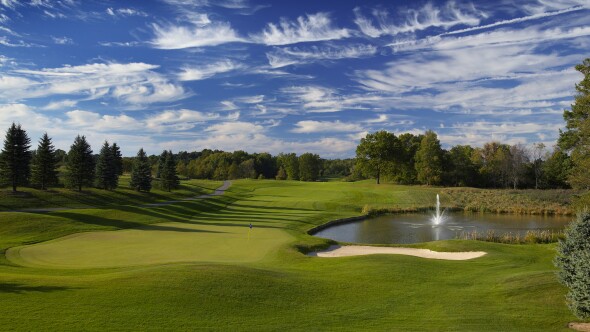
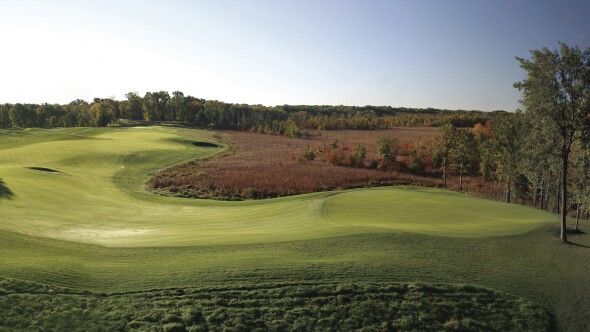
The layout itself is characterized by its maanaad kamagaa (Odawa for rolling landscape) and nbikensan (ponds; small marshes). Several fairways are pinched in the middle by water and trees, and a number of greens are tucked behind the nbikensan. The greens themselves range in size from smallish to quite large, with consistent but not dramatic undulation. Overshooting them will generally have very undesirable consequences. Four sets of tee boxes lend the course overall yardages from 6,424 from the tips down to 4,998 yards from the forward tees. Since many golfers who play here are still novices, you may find the championship tee markers are missing to dissuade players from getting in over their heads. (But if youre a low handicapper, feel free to play the unmarked tips anyway.)
Hole No. 1 is the most dreaded of all opening holes (for me, anyway): A short par 4 (291 yards) that requires precision with a long iron off the tee. The fairway then takes a sharp left turn past a fairway bunker, and youre left with anything from a sand wedge to a middle iron into the green, which is fronted on the right by nbikens (a marsh). (Odawa contains no curse words, so a fuller description of this opener is not possible in the language.)
The 454-yard, par-5 3rd doesnt look all that bad off the
tee. But beware: The fairway narrows drastically at the 150-yard
marker, with nbiish (water) right and OB left.
And if you place your tee shot short of the water, youll
have a long second shot just to lay up. The 378-yard, par-4 5th
presents golfers with a bit of a carry off the tee to a gently
left-to-right-sloping fairway. Another marsh lies in wait to the
left of this green, and if you fly the green, kiss your ball good-bye.
No. 11 (171 yards) is a top-notch par 3, especially playing into a 30-mph wind, as I was. Water flanks the right side of the hole from tee to green, making a right-front pin placement practically unapproachable. No. 13 (401 yards, par 4) is my favorite hole. The second shot here is possibly the prettiest on the course, over a rocky ziibiins (stream) to a large, two-tiered green nestled into an lovely grove of wiigwasag (yellow birch). Putting here, you practically expect Bambi, Thumper, Flower, and the whole Disney woodland gang to scamper out of the underbrush.
No. 16 is another 171-yard par 3, completely over water this time. The fountain in the pond is a nice touch, but the solitary boulder in front of the green is simply wicked: Im sure it has bounced more than one otherwise solid shot back into the nbiishish (darn water this is as close as one can come to swearing in Odawa).
Conditions at Mnidoo Valley are typical for many Canadian courses,
which means that Nature, in all her messy, gnarly, bio-orgiastic
splendor is never far removed from the fairways, greens, and tee
stations. I think that those of us who obsess over golf as it
is played (and more importantly presented) on TV or at posh resorts
forget that it is a game played in nature. And we are taken aback
when Nature actually extends her unruly tendrils onto the golf
course. But if you dont like a few weeds in the rough or
a few burrs in the hazards, well, by God, keep your ball in the
miishkoosan (short grass). And take a club
with you into the rough: Although they are quite rare, Mississauga
rattlesnakes can be found on the island.
Personally, I found the overall conditioning of the course to be admirable, considering the wild countryside it has been carved out of and the abominable conditions in which I played (the aforementioned gale winds, intermittent downpours, and chilling temperature). Soggy spots on the fairways were plentiful, but the greens even after a recent aeration were firm and true. And despite the wetness, I was not asked to keep my cart off the fairways. (Its just too hard to walk and take notes, OK?) If youre not lugging a camera and notebook, however, the course like most Canadian courses is laid out with walkers in mind. And since a cart costs as much as the green fees, walking is highly recommended.
The only real fault to be found with the playing conditions was something that the greenskeeper could not control: The entire round had me pondering the age-old question of which is more annoying on a golf course, nkawag (geese) or gyaashkwag (seagulls). Goose poop smells worse, but seagulls leave behind a litter of white feathers, which curl up and, from a distance, bear a vexing similarity to golf balls.
Mnidoo Valleys clubhouse offers a limited pro shop (clothing, balls, a few clubs), and a full-service, licensed restaurant. There is a practice green, but no practice range, the closest one of those being in the back yard of the B and B in Wikwemikong. However, if you want to try your hand at the Canadian national pastime of curling, there is an excellent indoor curling rink next door to the clubhouse, eh?
|
Manitoulin Island which, if Regis Philbin ever asks you, is the largest fresh-water island in the world draws masses of tourists in the summer months, who come for both the natural attractions (fishing, boating, sailing, hiking) and the cultural attractions (Native history, crafts, art galleries). Bed and Breakfasts, small hotels, and the exclusive Manitowaning Lodge Golf and Tennis Resort, which is across the street from the course, all offer visitors unsurpassed peace and quiet. Except, of course, during Wikwemikongs annual pow-wow, which draws somewhere near 50,000 attendees and participants each year from across North America.
Now, thanks to Mnidoo Valley Golf Club, golfers also have a good reason to visit this awe-inspiring, completely unique venue. Im not sure just which spirit is referred to by the name Mnidoo Valley, but one thing is certain: The true spirit of golf is alive and well at this course, where two communities and two cultures come together to tee it up.
Mnidoo Valley Assiginack Wikwemikong Golf Club
Box 12
Manitowaning, Ontario P0P 1K0
GM: Mark Stortini
Tel: 705-859-2888
Fax: 705-859-2072
E-mail: Mnidoo@amtelecom.net
Web: www.golfmanitoulin.com
Par: 72
Yardage: 6424 (blue), 5817 (white), 5247 (gold), 4998 (red)
Slope: 126, 123, 114, 111
Rating: 71.6, 68.8, 65.9, 64.6
Rates (CAN$): Weekday $15/9, $24/18; Weekend $17/9, $28/18; Cart
add $15/9, $25/18
Other information: Walking allowed any time; No alcohol sold on
premises; Accommodations available in Mindemoya, South Baymouth,
and Manitowaning, including Manitowaning
Lodge Golf and Tennis Resort; 2 hrs. from Sudbury, 5-1/2 from
Toronto, and 6 from London/S.W. Ontario